


Most parents who walk into a child assessment center for the first time carry the same quiet fear: What if something is really wrong? And right behind that fear is a second one: What happens after we find out?
That gap between “we noticed something” and “here is what we do about it” is where families spend a lot of anxious time. This article walks you through exactly what a structured assessment process looks like, why it matters more than a single diagnosis, and how a personalized development plan actually takes shape for your child.
Table of Contents:
What Does a Child Assessment Center Actually Do?
A child assessment center is not a diagnostic lab where your child receives a label and you leave with a folder. It is a comprehensive process, a collaborative, multidisciplinary evaluation that focuses on child development basics, exploring who your child is, how they function across different areas of life, and where they may need additional support.
At AIMS Child Development Center in Pattambi, Kerala, the assessment process involves a team that includes psychologists, speech-language pathologists, occupational therapists, special educators, and behavior analysts. They do not work in silos. Each professional sees the child, shares findings, and together they build one unified picture.
The evaluation covers several areas at once:
- Developmental milestones (physical, social, cognitive)
- Speech and language abilities
- Behavioral patterns and emotional regulation
- Sensory processing and motor coordination
- Parent and teacher observations
This matters because children rarely present with one clean, isolated concern. A child referred for an ADHD assessment, for example, may also show delays in language processing or sensory sensitivity that are contributing to the same classroom struggles. Looking at behavior alone would miss half the picture. That is exactly why a center-based, multidisciplinary evaluation is structured the way it is.
The Assessment Is Not the Finish Line
Here is what many parents do not know going in: the evaluation itself is just the beginning of a much more useful conversation.
Once the multidisciplinary team completes their observations and standardized testing, they compile a detailed report with specific recommendations. This is not a generic document. It reflects your child’s unique profile, covering both what they find challenging and where they show clear strengths.
That report becomes the foundation for the personalized development plan.
At AIMS, the chief consultant reviews all findings and guides enrollment into relevant therapy programs. If a child needs speech therapy, occupational therapy, and behavioral support simultaneously, the plan reflects that. Each therapist then works within their area, but toward shared monthly goals. Parents sit in on those progress reviews regularly.
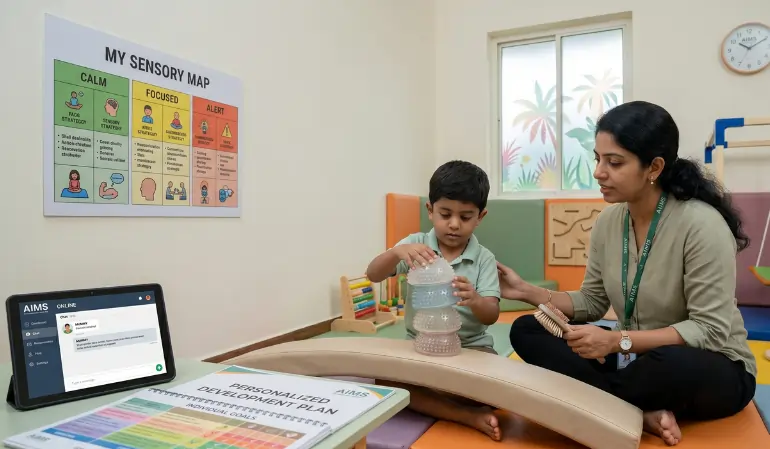
How a Personalized Development Plan Takes Shape
A personalized plan is not a checklist. It is a living document that changes as your child changes.
In the early stages, therapy hours tend to be more intensive. The team focuses on foundational skills. As the child builds those skills, the plan shifts. At AIMS, when a child moves closer to school age, the emphasis gradually transitions from therapy sessions toward school readiness skills and academics. Therapy hours are reduced. Schooling support increases. The goal is always independence, not permanent dependence on intervention.
For children where an ADHD assessment has flagged attention and impulse regulation concerns, the behavioral therapy component of the plan becomes especially detailed. Therapists work on structured routines, reinforcement strategies, and techniques that also transfer to the home environment. Parents are given specific guidance on how to support the same goals outside of sessions.
Why Parental Involvement Changes Everything
No plan works if it only exists inside a therapy room.
At AIMS, the best child development center in Kerala, after every session, parents can meet directly with the therapist to understand what was worked on, what progress was observed, and what to reinforce at home. This is not optional. Parent involvement is considered a core part of the intervention, not a bonus.
When a child sees the same approach at home and at the center, they progress faster. Behaviors that feel confusing at home start to make more sense when parents understand the developmental context. And families stop feeling like outsiders in their child’s care.
Online and Offline Access at AIMS, Pattambi
Families in Kerala who cannot travel regularly to Pattambi can still access assessment follow-ups and therapy sessions online. AIMS offers video-based and phone-based services for children who live farther away or who feel more comfortable in a home setting.
Final Thoughts
The moment between noticing something and actually knowing what to do about it is one of the hardest places for a parent to sit. A good child assessment center shortens that gap significantly. It gives you information, yes. But more than that, it gives you direction.
If your child has been showing signs that concern you, whether in speech, behavior, attention, or social development, an honest and thorough evaluation is the most useful next step you can take.
FAQ
Your child meets with different specialists who observe how they communicate, play, respond to instructions, and handle tasks. It is more of a conversation and structured activity session than a formal test. The team is watching specific things, but your child does not need to “perform.” Parents are usually present and are asked for their own observations too.
A diagnosis tells you what is happening. A development plan tells you what to do about it. The plan includes specific goals for each area of need, which therapists are involved, how progress gets measured, and how parents can support the work at home. It is practical, not just clinical.
Early is generally better, but there is no age that is too late. AIMS works with children from newborn stage onward. If something feels off at two years old or at seven, it is worth getting a professional look. Waiting to see if the child “grows out of it” often costs time that could have been used for intervention.
Yes. A multidisciplinary center like AIMS conducts behavioral and psychological evaluations that can identify ADHD alongside other conditions. The ADHD assessment looks at attention patterns, impulsivity, and how these show up in different settings. Findings from parents and teachers are included in this process.
AIMS offers online therapy and follow-up sessions through video and phone calls. Some parts of the initial assessment may require an in-person visit, but ongoing therapy and parent consultations can happen remotely.