

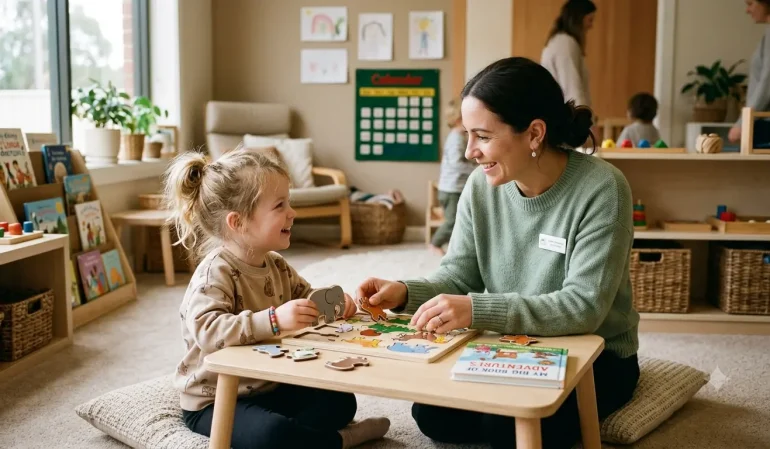
A school support program becomes necessary the moment a child starts dreading Monday mornings for reasons that have nothing to do with laziness. Maybe it is a nine-year-old who cries before the school van arrives or a ten-year-old who can read fluently at home but freezes the second a teacher calls on them in class. These are not discipline problems. They are signals that something in the classroom pace, whether it is attention, communication, or emotional regulation, is not matching what the child actually needs. Structured support outside school hours gives these children room to catch up without falling further behind.
Table of Contents:What Does a Child Development Center in Kerala Actually Do?
After that first assessment, a plan takes shape. Progress gets reviewed monthly, with parents sitting in on those reviews rather than hearing about them secondhand. The goal, over time, is a gradual shift: therapy hours taper down as the child’s regular schooling hours and independence increase. That structure matters more than any single technique, because it treats the classroom struggle as connected to everything else going on with the child, not as an isolated behavior to fix.
How an After School Support Program Works in Class?

Why School-Related Anxiety Deserves Early Attention?
School-related worries are consistently reported as one of the most common concerns among children who experience anxiety, and researchers point to specific classroom factors, including negative peer evaluation, extended separation from caregivers, and academic pressure, as contributing risks. For children who already have an unmet learning or developmental need, that pressure compounds. A child who cannot keep up with reading speed is not just behind academically. They are also absorbing daily evidence that they are different from their classmates, which is where anxiety tends to take root.
han it saves. Early evaluation does not require certainty about what is wrong. It requires noticing a pattern, whether that is avoidance, meltdowns before school, or a consistent gap between what a child can do at home and what they manage to show in class, and getting that pattern looked at by people trained to separate ordinary childhood moods from something that needs structured support.Final Thoughts
Getting a child from school anxiety to classroom confidence rarely happens through one conversation or one good week. It happens through consistent, structured hours where a child practices the specific skill they are missing, whether that is reading fluency, peer conversation, or simply sitting through a full lesson without shutting down. If your child has been showing signs of struggle at school, what pattern have you noticed first, the academic gap, the behavior, or the anxiety itself?
FAQ
How do I know if my child needs a school support program or just extra tutoring?
Tutoring targets a specific subject gap. A support program looks broader, covering attention, behavior, and emotional regulation alongside academics. If your child struggles across several areas, not just one subject, that is usually the signal to look at structured support rather than a private tutor.
What age is too young or too old to start an after school program?
There is no strict cutoff. Programs like this typically work with school-age children, adjusting the mix of academic help, social skills work, and behavioral support to match the child’s stage. Starting earlier tends to mean less catching up later, but older children still benefit from structured sessions.
My child seems fine at home but struggles only at school. Does that still count as an issue?
Yes, and it is actually a common pattern. Kids often mask difficulties at home, where the environment is familiar and low pressure. School introduces noise, pace, and peer comparison all at once, which is exactly where gaps in attention or emotional regulation tend to surface first.
Will my child need therapy forever once they start this kind of program?
No. The typical approach reduces therapy hours as a child gains independence and their regular schooling hours increase. Progress gets reviewed regularly, and the plan adjusts based on how the child is actually doing, not a fixed timeline set at the start.
How much should I as a parent be involved once sessions begin?
Quite a bit, ideally. Parents who sit in on progress reviews and reinforce small strategies at home tend to see faster, steadier improvement. A child picks up on whether the new habits matter outside the therapy room, and parental involvement is usually what signals that they do.