Communication difficulties in children rarely show up in just one form. A child might struggle to pronounce certain sounds and, at the same moment, refuse to sit through a session or melt down when asked to repeat a word. Parents often start with a speech evaluation, only to learn that pronunciation is just one part of the picture.
Table of Contents:When Does a Child Struggle to Say It?
Some children have a clear speech delay. They are not talking the way other kids their age do, or their words come out unclear, as if the sound gets stuck somewhere between the mind and the mouth. This is one reason speech therapy in Kerala has become easier to access over the past decade, with trained speech-language pathologists working directly with families instead of asking them to travel long distances for a single session.
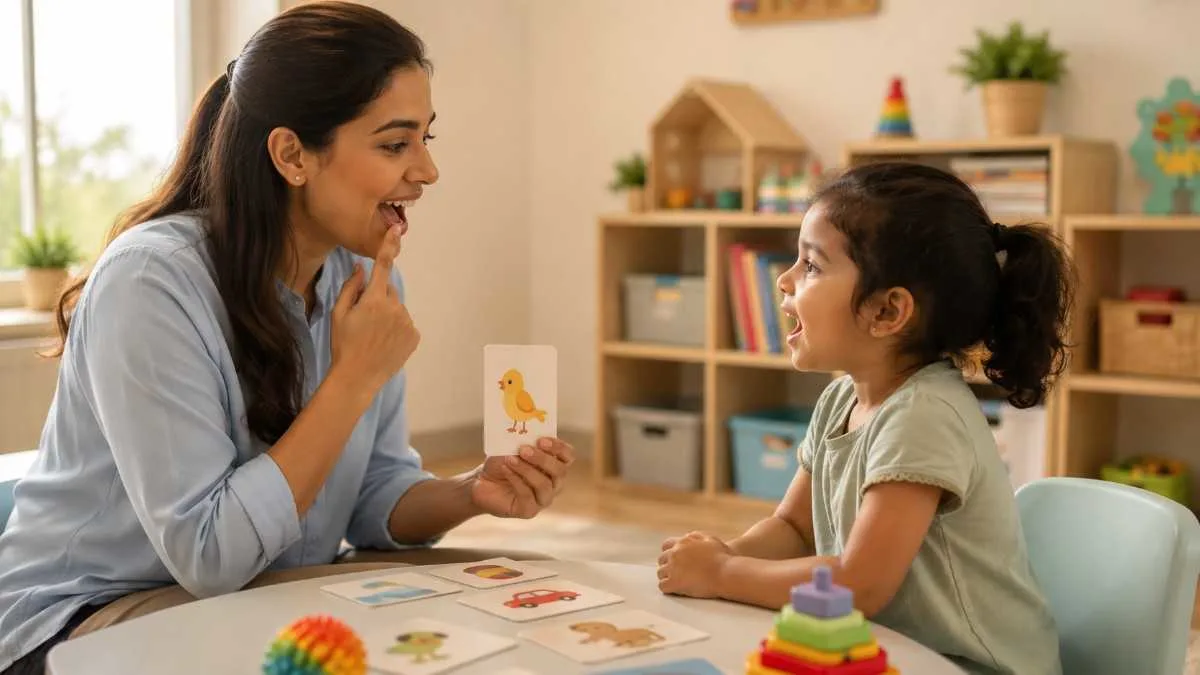
At a child development centre, speech therapists assess how a child forms sounds, builds sentences, and follows instructions. One approach used at the centre is the Cycles Approach, where a therapist works on different sound patterns each week rather than drilling a single sound until it sticks. Children with articulation issues, stammering, or slow language growth tend to respond well to this rotating structure, since it keeps sessions varied instead of repetitive.
When Does a Child Struggle to Show It?
Autism Spectrum Disorder and ADHD are the two conditions parents mention most when they ask about this therapy, but that is not the full list. A child dealing with anxiety, or one who has grown oppositional at home and at school, ends up in the same waiting room just as often. So does a child with no diagnosis at all, whose tantrums only started after their words stopped keeping up with what they wanted to say.
Communication Difficulties in Children: Why Speech and Behavior Overlap
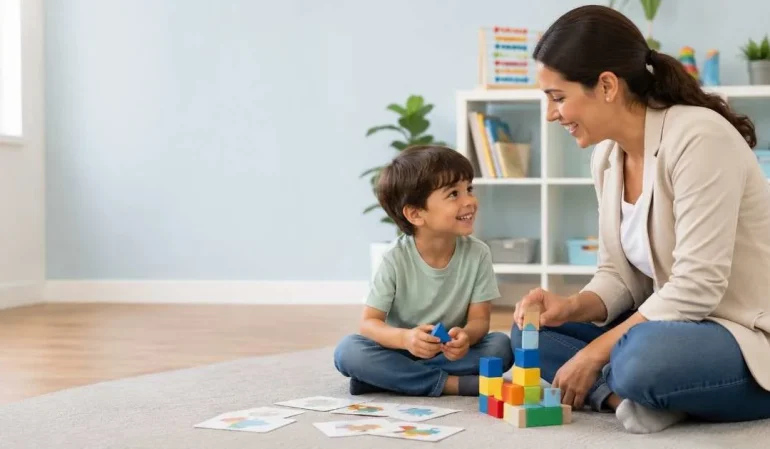
Communication difficulties in children are rarely confined to a single therapy room. A child who cannot express a need through words may express it through behavior instead: a shove, a scream, or a refusal to engage. Speech therapy alone can build the vocabulary, but if a child never developed the emotional regulation to use those words calmly, the frustration tends to resurface in another form.
Guidance from the American Speech-Language-Hearing Association points to a consistent link between language delays and behavioral or social-emotional difficulties in early childhood, particularly when a delay goes unaddressed past the toddler years.
How AIMS Combines Speech and Behavioral Therapy in Pattambi
AIMS Child Development Centre treats speech and behavior as connected rather than separate departments. A child enrolled for speech therapy may also be reviewed by the behavioral therapy team if tantrums, poor eye contact, or a short attention span show up alongside the speech delay. The centre’s multidisciplinary team, which has supported more than 10,000 children over ten years, includes speech-language pathologists, behavioral therapists, occupational therapists, and counsellors who track each child’s progress monthly.
Sessions run both online and at the Pattambi centre, which matters for families who cannot manage a weekly commute. Parents sit in on progress reviews rather than just receiving a final report, a practice the centre notes helps reduce a child’s fear or hesitation around therapy over time.
What Parents Can Watch For at Home
A few signs tend to appear together when both speech and behavior need attention. A child might avoid answering questions directly, struggle to sequence a simple story, or show poor eye contact alongside unclear pronunciation. None of these signs alone confirms a diagnosis, and developmental pace varies from child to child, which is why the CDC’s Learn the Signs Act Early program recommends tracking a child’s communication and social milestones against age-based checklists rather than comparing to siblings or classmates.
What matters more than the exact age a delay gets noticed is how quickly it gets a proper assessment.
Final Thoughts
Speech and behavior are not two separate problems wearing different names. For many children, they are two sides of the same difficulty. One shows up in the mouth, the other in the body and the reactions around it. Addressing only one side often means the other quietly resurfaces months later.
If a child’s communication struggles come with meltdowns, poor focus, or withdrawal, it may be worth asking whether speech therapy or behavioral therapy alone is enough, or whether the two need to work side by side. What has your child’s evaluation shown so far, one gap or several?
FAQ
How do I know if my child needs both speech and behavioral therapy?
Watch for overlap. If your child struggles to talk and also melts down, avoids eye contact, or tunes out instructions often, both areas are worth checking. A combined assessment usually catches this faster than starting with just one therapy type and waiting to see what else surfaces.
Can behavioral therapy help a child who isn't talking yet?
Yes. Non-verbal children often use behavior to communicate frustration or unmet needs. Behavioral therapy builds calmer response patterns while speech therapy works on actual words, and the two usually move faster together than either one does on its own.
What age should speech therapy start for a communication delay?
Earlier tends to work better. Some centres, including AIMS, begin services from the newborn stage in certain cases, since early brain development happens fast. Waiting rarely helps matters, and catching a delay early often shortens the overall therapy timeline.
Does my child need a diagnosis before starting behavioral therapy?
Not necessarily. Plenty of children without a formal diagnosis like ASD or ADHD still benefit from behavioral therapy, especially if frustration from communication gaps is turning into tantrums or withdrawal. A proper assessment will clarify what is actually going on.
How long before parents see progress with combined therapy?
It varies by child and condition. Counselling-related shifts can show up within weeks, while speech and behavioral gains, especially around stammering or ABA-based goals, usually take longer and depend heavily on how consistently sessions and home practice happen.