

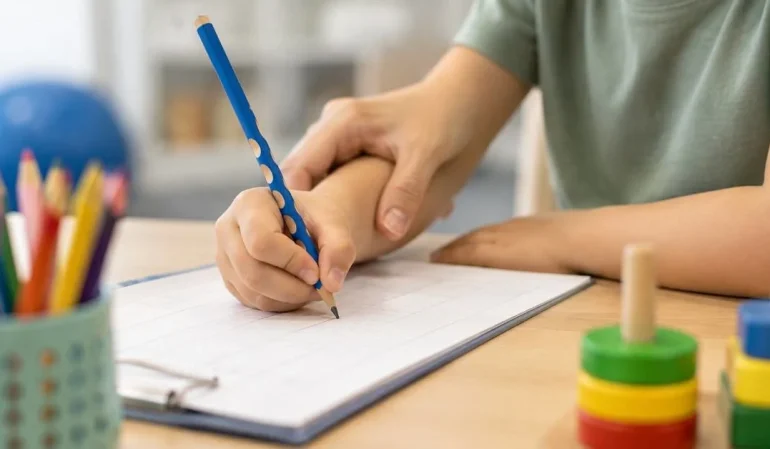
A four-year-old who refuses to touch playdough, or a seven-year-old whose handwriting turns every homework session into tears, might be showing early occupational therapy signs in children rather than plain stubbornness. Parents often wait months, sometimes longer, before raising these patterns with anyone, mostly because the signs look like personality traits instead of developmental flags. Catching them sooner changes the timeline for support.
Occupational therapy works on the skills children need for what therapists call daily occupations: dressing, eating, writing, playing, and connecting with other people. It doesn’t treat a diagnosis directly. It treats the gap between what a child needs to do each day and what they can currently manage on their own.
Table of Contents:What Are the Common Occupational Therapy Signs in Children?
Most therapists suggest an assessment once three or more signs show up together, since isolated quirks are common and not always a concern on their own. Fine motor struggles are usually the first thing a parent notices. A child who can’t hold a pencil, crayon, or spoon the way classmates do, or who avoids buttons and zippers well past the age where peers manage them, is often flagging a coordination gap rather than laziness.
Sensory avoidance forms the second cluster. Refusing messy play, covering ears at moderate noise, or reacting strongly to certain fabrics and food textures all fit this pattern. Balance and body awareness matter too. Frequent tripping, reluctance to join physical games, or visible hesitation on stairs and playground equipment can point to gaps in gross motor planning.
On the attention side, a child who cannot sit through a meal or a short story, or who struggles to follow a two-step instruction, may need support with regulation rather than discipline. Social signs round out the list: difficulty joining group play, trouble reading other children’s cues, or handwriting that comes out slow and uneven despite real effort.
None of these signs alone confirms a need for therapy. Clustered together and persistent over weeks rather than days, they’re worth a conversation with a qualified therapist.
What an Assessment Looks Like
Families searching for occupational therapy Kerala often expect a single test with a pass or fail result. The actual process runs closer to a structured evaluation. A therapist observes fine motor skills, gross motor ability, sensory processing, self-care tasks, and handwriting, then builds a picture of where a child sits against typical developmental ranges. The Centers for Disease Control and Prevention tracks broad developmental milestones by age, which gives families a general reference point, though a formal OT assessment goes into far more detail than a milestone checklist.
Once the assessment is done, most programs set three to five measurable goals rather than vague intentions, such as improving pencil grip within eight weeks or managing a morning routine independently by month’s end. Sessions that follow tend to be play-based for younger children, built around activities like threading beads, playdough work, or balance boards, so the child experiences therapy as a game rather than a clinical exercise. Parents typically receive a home program to keep momentum going between visits, and progress gets reviewed at set intervals so goals can shift as the child grows.

When Counselling Complements Occupational Therapy
Motor and sensory signs sometimes travel alongside emotional ones. A child who avoids school, withdraws from friends, or shows sudden shifts in mood may need child counselling running alongside OT rather than instead of it. Counselling gives a child space to talk through frustration, especially when handwriting struggles or sensory overwhelm have started affecting how they feel about themselves. The two services address different layers of the same picture: one builds physical and sensory skill, the other supports the emotional weight that often comes with falling behind peers.
Centres that offer both under one roof tend to coordinate care so a child isn’t repeating their story to a new provider every few months. That continuity matters more for younger children, who often struggle to put what they’re experiencing into words in the first place.
Final Thoughts
Spotting occupational therapy signs in children early doesn’t mean assuming the worst. It means paying attention to patterns that repeat, checking them against a professional assessment, and deciding from real information rather than guesswork. If a handwriting struggle, a sensory reaction, or a coordination gap has been showing up for weeks rather than days, a conversation with an occupational therapist is a reasonable next step. What signs have you noticed in your own child, and how long have they been showing up?
FAQ
How do I know if my child needs a school support program or just extra tutoring?
Toddlers often show early hints through fine motor delays, avoiding textured foods, or reacting strongly to loud rooms. Balance struggles and trouble following simple two-step directions add to the picture. A single sign rarely means much on its own. Watch for a cluster that repeats across several weeks before assuming therapy is needed.
At what age should I get my child assessed for OT in Kerala?
AIMS CDC evaluates children as young as twelve to eighteen months, right through their school years. Earlier assessment tends to shorten the path to measurable progress, particularly for sensory and fine motor concerns. There’s no fixed cutoff age, so a first conversation with a therapist is worth having whenever a pattern feels persistent.
Can occupational therapy help if my child also needs counselling?
Yes, and the two often run together rather than one replacing the other. Occupational therapy builds physical and sensory skills, while counselling addresses the emotional strain that can come from struggling with those same skills. Centres offering both under one roof usually coordinate care so a child tells their story once.
How long does occupational therapy usually take before I see progress?
Timelines vary by child. Some families notice meaningful change within eight to twelve weeks, especially for narrow goals like pencil grip. Children with more complex needs may continue for six months or longer. A therapist will typically give a realistic estimate once the initial assessment is complete
What happens during the first occupational therapy session?
The first visit works as an evaluation rather than a treatment session. A therapist observes the child completing everyday tasks, asks parents about routines and difficulties at home, and may use standardised tools to gauge current functioning. Families typically leave with a summary of findings and a sense of the next steps.