

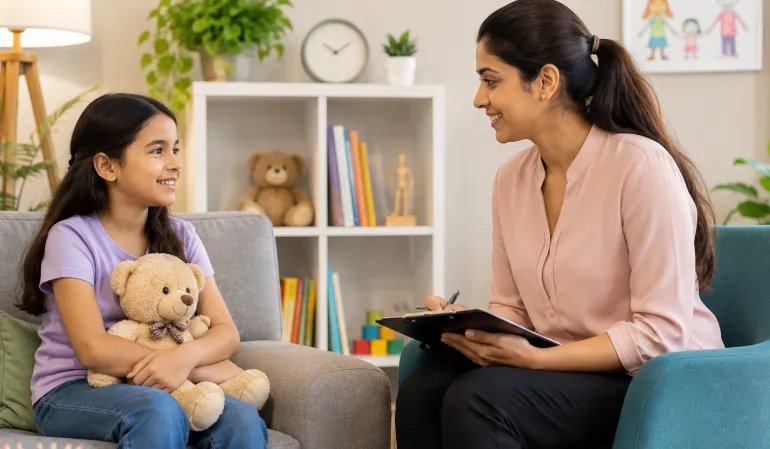
Most parents who consider counselling for children picture something clinical. A stiff couch, a stranger with a notepad, and a child sitting across the room not knowing what to say. That image stops a lot of families from taking the first step.
Here is the truth: a child counselling session looks nothing like that.
Table of Contents:
What Does a Child Counselling Session Actually Look Like?
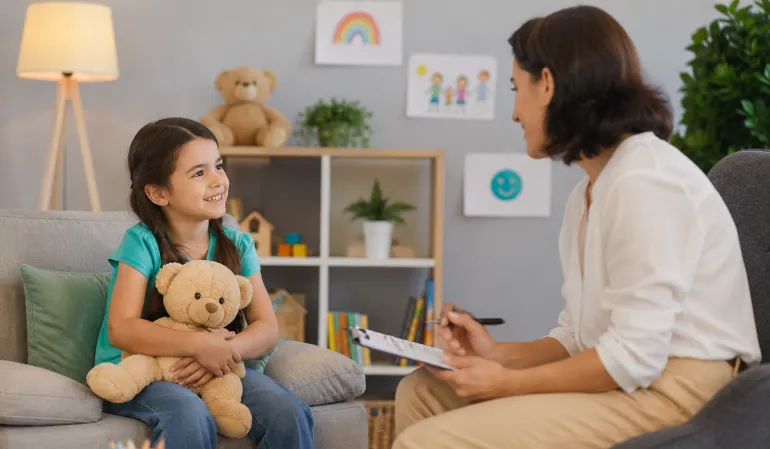
The room is usually warm and familiar. There are toys, art supplies, and games. The counsellor’s job in the very first few sessions is not to ask hard questions. It is simply to become someone your child trusts.
At AIMS, the best child development center in Kerala, sessions begin with exactly this. Building trust comes first, and only then does the real work follow. Play is central to the process because play is how children communicate. They say through action and imagination what they cannot yet put into words.
So no, your child will not be sitting in a chair answering questions. They will probably be drawing, playing, or doing a quiet activity while a trained professional gently understands what is going on inside.
Why Would a Child Even Need Counselling?
Parents often ask this. And it is a fair question, because children look fine most of the time. They go to school, eat their meals, and play with their friends. The signs that something is off can be easy to miss.
Counselling for children becomes relevant when you notice things like sudden mood changes, frequent anger that seems out of proportion, withdrawal from friends or activities they once loved, trouble focusing in school, or negative things your child says about themselves. These are not phases to wait out. They are signals worth paying attention to.
According to AIMS, children who benefit from counselling include those showing drops in school performance, increased irritability, loss of interest in hobbies, difficulty with peer relationships, and in more serious cases, expressions of sadness or hopelessness. The range is wide. You do not have to wait until things are severe.
The Role Parents Play (It Is Bigger Than You Think)
One thing that surprises most families is that mental guidance is not something that happens only between the counsellor and the child. Parents are part of the process throughout.
At AIMS, the approach treats the family as a team. The counsellor understands your child’s world, which includes you, your home environment, and the relationships around them. Parents are kept informed and involved. Sessions are not a black box.
This also helps at home. When families understand what the child is working through, communication improves. Children become more willing to talk openly when they see that emotional health is treated seriously by the adults in their lives.
How Is Progress Measured in Counselling for Children?
Progress looks different for every child. Some children open up quickly. Others take time. The counsellor at AIMS tracks how the child is coping, whether they are using strategies they have been taught, and how their daily life is being affected.
Small goals are set with the child’s participation. This matters because when children have a say in their own growth, they feel capable rather than treated. That sense of agency builds confidence over time.
Sessions are structured around your child’s pace and comfort, not a fixed timeline. The child, in a sense, leads. The counsellor guides.
The Bigger Picture: Why This Is Not a Big Deal
There is still stigma around seeking help for children’s mental health. Some parents worry their child will be “labeled” or that seeing a counsellor means something is seriously wrong.
Neither is true.
Going to counselling is like going to a doctor when your child has a persistent cough. It is proactive, not reactive. It means you noticed something and you chose to act. That is good parenting.
AIMS describes this well: the goal is to normalize mental health care so children understand that caring for their emotional health is just as important as caring for their physical health. When children grow up seeing mental health this way, they carry that understanding with them for life.
Final Thoughts
If you have been on the fence about exploring counselling for your child, let this be the nudge that helps you move forward. One conversation with a professional costs nothing in comparison to what untreated struggles cost a child over time.
AIMS Child Development Center, one of the well-regarded child development centers in Kerala with over 10 years of experience and more than 5,000 sessions conducted, offers counselling that is professional, play-based, and genuinely child-centered.
FAQ
Honestly, the line between a phase and something that needs attention is how long it lasts and how much it affects your child’s daily life. If the mood change, the withdrawal, or the anger has been going on for a few weeks and is affecting school or friendships, it is worth talking to a professional. Waiting it out sometimes works. But sometimes you lose months that matter.
Not much pressure, actually. The first session is mostly about the counsellor getting to know your child in a relaxed way. Through play or light activities, they build a sense of safety. Nothing heavy happens on day one. That is intentional.
No. That is the point of play-based counselling. Children express what they cannot say out loud through what they do, draw, or play. The counsellor is trained to read those signals. Your child shares at their own pace.
What your kid shares stays private. Counsellors do not report to schools. Parents are kept informed about the general progress and approach, but private disclosures between the kid and counsellor are protected. The kid needs to trust that space.
Children can benefit from counselling from quite a young age. Even preschool-age toddlers can attend play-based sessions. There is no age that is too young if the toddler is showing signs of emotional distress or behavioral challenges.