
This article looks at why the combination works, what each therapy actually contributes, and how a team handling all three keeps a child moving forward instead of pulling them in three directions at once.
How Speech Therapy Kerala Sessions Pick Up Where ABA Leaves Off?
ABA therapy focuses on behavior. It breaks a skill or a response into small steps, reinforces the version that works, and repeats it until it holds. That process is useful, but it does not automatically teach a child new words or new ways to combine them. This is where speech therapy Kerala programs come in.
A speech therapist looks at whether a child understands language, produces sounds correctly, and can string ideas into a sentence a listener can follow. Speech therapy addresses speech delays, articulation difficulties such as substituting one sound for another, stuttering, and the communication challenges that often accompany autism or ADHD. A child in ABA therapy who is learning to request a toy instead of grabbing it still needs the actual words to make that request. Speech therapy supplies them.
What ABA Therapy Covers and What It Does Not?
This approach suits reducing behaviors that get in the way of learning, such as tantrums during transitions, difficulty following instructions, and trouble sitting through a task. What it is not built to do is develop fine motor coordination or sensory regulation on its own. A child can learn to sit still through ABA and still struggle to hold a pencil once seated. That gap is where occupational therapy steps in.
Where Does Occupational Therapy Kerala Support Close the Gap?
Put next to ABA, the pairing makes practical sense. ABA can shape a child’s willingness to try a task. Occupational therapy builds the physical skill to actually do it. A child who has learned through ABA to stay at the table for a writing task still needs the hand strength and grip pattern that occupational therapy develops before that writing looks anything close to age-appropriate
Why One Team Handling ABA, Speech, and Occupational Therapy Works Better Than Three Separate Ones?
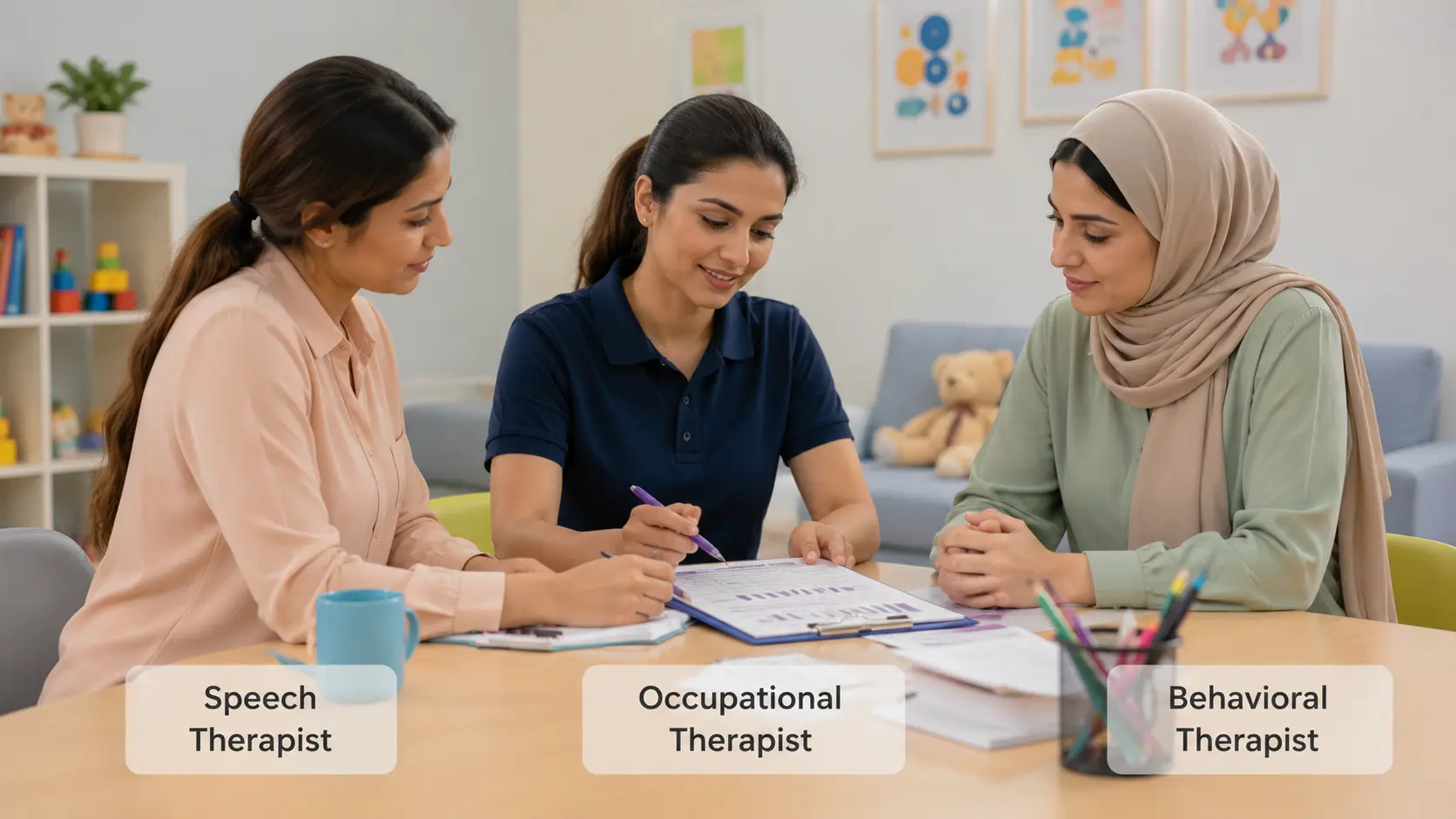
Parents are treated as part of that team too. Progress reviewed only inside a clinic, without a home routine reinforcing it, tends to move slowly. A structure where gains from an ABA session, a speech session, and an OT session reinforce each other in the same week works better than three appointments competing for a child’s attention.
Final Thoughts
FAQ
Yes, and for many children that is exactly how it should work. Running both in the same week means the words a child is learning in speech sessions get reinforced during ABA training too, instead of sitting as two unrelated skills.
No, they cover different ground. Occupational therapy builds motor and sensory skills, while this therapy shapes behavior and responses. Most children on the autism spectrum benefit from having both rather than choosing one over the other.
Watch for gaps ABA is not closing. If your child follows instructions better but still struggles with handwriting, texture sensitivity, or forming full sentences, that usually points to a need for occupational or speech therapy alongside it.