

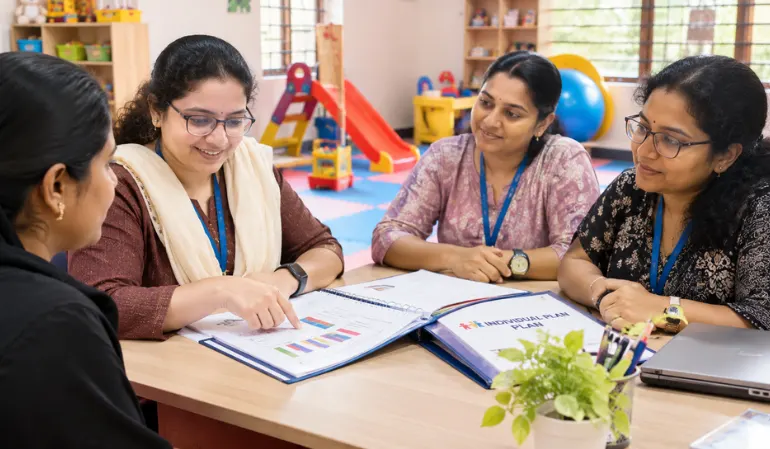
Some children say “la” where the word needs “ra”. Others read well but stall at maths or cannot hold focus through a lesson. Needing extra support does not mean something is wrong with the child, and it often shows up in early classrooms before anyone names it. That is where special education teaching begins, and an early childhood education (ECE) qualification already covers part of the groundwork. Here is what the role involves, which ECE skills carry over, and where a teacher sits inside a wider team.
Table of Contents:What Special Education Looks Like Day to Day
Special education is teaching designed for children who learn differently or face challenges in school. It builds on a child’s strengths, finds weak areas such as mathematics, and supports those areas directly.
Most children stay in regular classrooms and receive extra help, such as more time on tests, one-on-one support, or special learning tools. Some spend part of the day in a smaller group with a specialised teacher. A few schools, often private, are built around needs like autism or dyslexia. Parents, teachers, and specialists draw up an individual plan, called an IEP, and revise it as the child grows.
Why Early Years Training Fits This Work
Development moves in stages from newborn to school age, and the earliest window carries weight for speech. One Kerala centre calls ages 0 to 2 the critical period because brain development is at its peak, and its services start from the newborn stage.
Play and themes run through the work. Child counsellors use play because it is a child’s natural language, so feelings without words yet can still come out. Educators use unit studies, where every subject sits under one theme, so a child on the autism spectrum or with a learning difference is not switching gears all day. Anyone who has planned a themed week for preschoolers will recognise the logic.
The need also shows in how services are built. Some centres offer therapy over video or phone for families who live far away, so distance matters less.
Everyday Strategies Behind Special Education Teaching
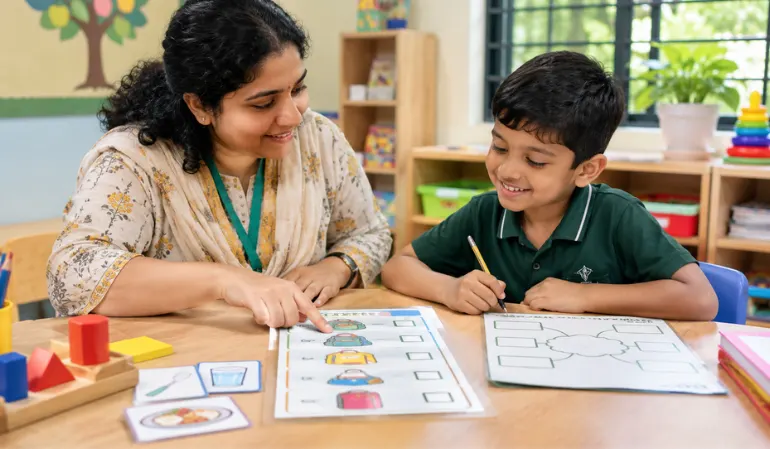
The toolkit is practical. Teachers pre-teach vocabulary before a lesson, repeat skills inside steady routines, and set goals that are neither too high nor too low. Visual aids, graphic organisers, and step-by-step checklists carry much of the load. Lessons can link to a child’s own interests, and alternate assignments suit different learning styles. Fewer concepts per lesson help a child who feels overwhelmed, and frequent checks show whether a method is working.
Behaviour gets a plan too. A Behaviour Intervention Plan, or BIP, sets out how a recurring challenge will be handled. Physical activity is recommended as well, since it can lower stress and anxiety and improve social interaction. Text-to-speech tools and interactive games help some children reach the lesson.
You Will Not Work Alone
Special education teaching rarely happens in isolation. A first assessment maps where a child needs help. The team that follows may include an occupational therapist, a speech therapist, a developmental educator, and a behaviour therapist when behaviour is a concern, with a paediatrician or physiotherapist added for physical needs. Evaluation can take four or five sessions, sometimes more. Progress is reviewed monthly with parents, and ideally therapy hours fall as school hours rise once enrolment begins.
A speech-language pathologist, listed at one centre with a BASLP qualification, leads speech therapy Kerala. The work covers late talking, stuttering, unclear sounds, and voice problems. One method, the Cycles Approach, rotates through patterns such as final sounds and blends week by week, and parents are guided on home practice.
Child counselling covers the emotional side. Counsellors guide children to understand their feelings instead of telling them what to do, and they keep parents involved. Teachers often notice the first signs: a sudden mood change, a drop in school results, school refusal, or withdrawal from friends. Noticing is not diagnosing. Describe what you see and let a qualified professional assess. If a child talks about hopelessness or self-harm, seek professional help promptly.
Final Thoughts
Working with children who learn differently asks for patience and close observation. Early years training gives a base in development and play, and further qualification fills in the rest. This article is educational and does not replace assessment by a qualified professional. Teams like AIMS in Pattambi run special education, speech therapy, and counselling as connected services. Which of those three would you want to understand better first?
FAQ
What does a special educator do all day?
Mostly adapting lessons. Content gets broken into smaller steps, supported with visuals and checklists, and checked often. Many children remain in regular classrooms and receive extra time, one-on-one help, or learning tools, so the educator tailors support each plan.
Can an ECE graduate move into this field?
Possibly, but check the credentials each role lists. Early years training covers development and play, which this work leans on. Some roles ask for a D.Ed.Spl.Ed. or a B.Ed. in Special Education, so confirm requirements before enrolling anywhere.
When should speech therapy start?
Earlier tends to help. One Kerala centre names ages 0 to 2 as the critical window and says therapy can begin between six months and three years. A qualified speech therapist decides timing after assessing the child.
How do I know if a child needs counselling?
Watch for changes such as sudden irritability, a drop in school performance, avoiding friends, or losing interest in favourite activities. Talk of hopelessness or self-harm needs prompt attention from a qualified professional. A counsellor can then assess what support fits.