A four-year-old who cannot yet name what she is feeling will usually show it instead. A sudden tantrum over a shared crayon. Silence when a teacher calls her name twice. Early childhood education programs exist for exactly this window, when a child is learning language and emotional control at the same time and often needs structured support to keep both moving together.
Parents tend to focus first on letters and numbers. But the quieter skills, waiting your turn, reading a friend’s frustration, calming down after a setback, are the ones that carry a child through school and beyond it.
Table of Contents:How Early Childhood Education Programs Structure Support?
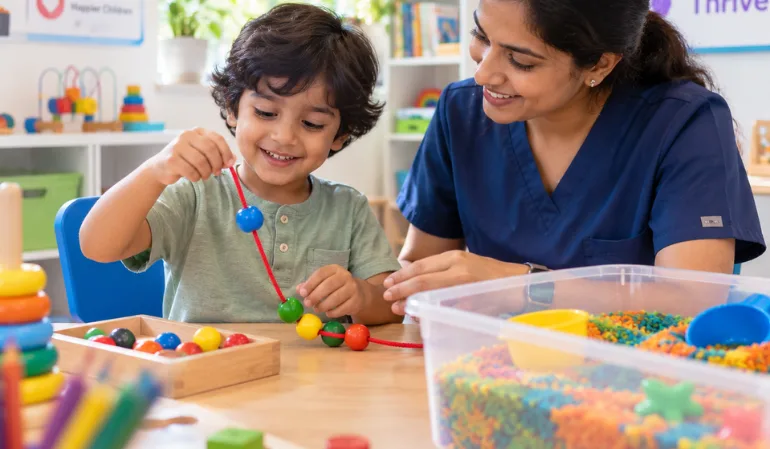
At a child development center in Kerala, the work rarely sits inside one classroom or one specialist’s office. A center built around this stage usually organizes support across three connected areas: speech development, occupational skills, and emotional or behavioral guidance. The idea is that a child’s frustration in class, trouble holding a pencil, and difficulty forming sentences are often threads of the same knot, not separate problems.
The process typically opens with an assessment. A therapist observes how the child plays, communicates, and reacts to small challenges, then maps out where the gaps sit compared to what’s expected for that age. From there, a small team, often including a speech therapist, an occupational therapist, and a counselor, works from a shared set of goals rather than running parallel, disconnected sessions. Parents sit in on progress reviews, because a skill practiced only inside a therapy room rarely survives the walk home.
Children with autism spectrum disorder, ADHD, or sensory processing differences are among those who benefit most from this kind of targeted, play-based work, and the Mayo Clinic’s overview of autism spectrum disorder is a useful starting point for parents who want to understand the diagnostic picture before an assessment.
Why Child Counselling Belongs in Every Early Learning Plan
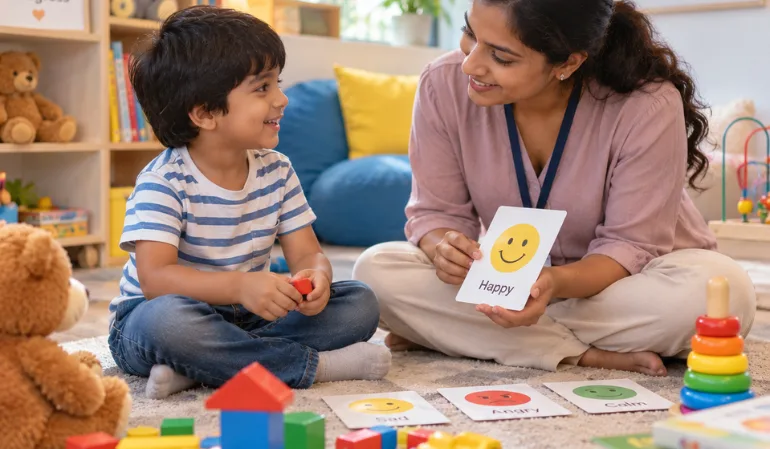
Academic pressure is not the only thing that weighs on a young child. School transitions, sibling rivalry, or simply not having the vocabulary to explain a bad day can build up quietly. Child counselling gives that pressure somewhere to go.
A counselor working with a young child leans heavily on play rather than direct conversation, because play is often the only language a child has for feelings that are too big for words yet. Through this, a child learns to name an emotion instead of acting it out, and a family often notices calmer evenings and fewer unexplained meltdowns within a few sessions. The goal is never to hand the child a fixed script for behaving well. It is to help the child recognize when something is wrong and to feel safe enough to say so.
Signs a Program Is Actually Working
Progress in this stage is rarely dramatic. It shows up as a child who used to refuse group games now joining one for five minutes. A child who threw the pencil is now scribbling with less frustration. A child who avoided eye contact is now looking up when her name is called.
Parents should expect regular, honest updates, not vague reassurance, and a plan that shifts as the child grows rather than staying fixed for a year. If a program cannot explain, in plain terms, what specific goal a session is working toward, that is worth asking about directly.
Final Thoughts
Choosing early childhood education programs is rarely about fixing a single problem. It is about giving a child the tools to handle frustration, connect with peers, and walk into a classroom without dread. What has your child’s school or therapy team told you about their social development so far, and does it match what you’re seeing at home?
FAQ
How early is too early to start looking into this kind of support?
Honestly, earlier beats later almost every time. If you’re noticing gaps by age two or three, that’s already a reasonable moment to get an assessment. Waiting until school starts often means the child has had more time to build frustration around the very things you’re trying to help with.
My child talks fine at home but shuts down at school. Is that still something to look at?
Yes, and it’s more common than most parents realize. Kids often mask difficulties in familiar settings and struggle where the environment is less predictable. A teacher’s observation combined with a professional assessment usually paints a clearer picture than home behavior alone.
What actually happens in a first assessment session?
Nothing scary, promise. A therapist watches how your child plays, talks, and reacts to small tasks, then asks you questions about daily routines and any concerns. You’ll usually get a summary of findings and next steps before you even leave the room.
Do these programs replace regular school or work alongside it?
Alongside, almost always. The therapy hours are meant to build skills your child then uses in a regular classroom. Most centers actually reduce therapy time as school participation increases, rather than treating the two as competing tracks.
How do I know if it's working or if we need a different approach?
Watch for small, specific changes rather than a total transformation. Better focus for ten more minutes, fewer meltdowns over transitions, and more willingness to try something new. If months go by with no movement on the goals set at intake, that’s a fair reason to ask for a plan review.
Building Social Skills Through Occupational Therapy in Kerala