

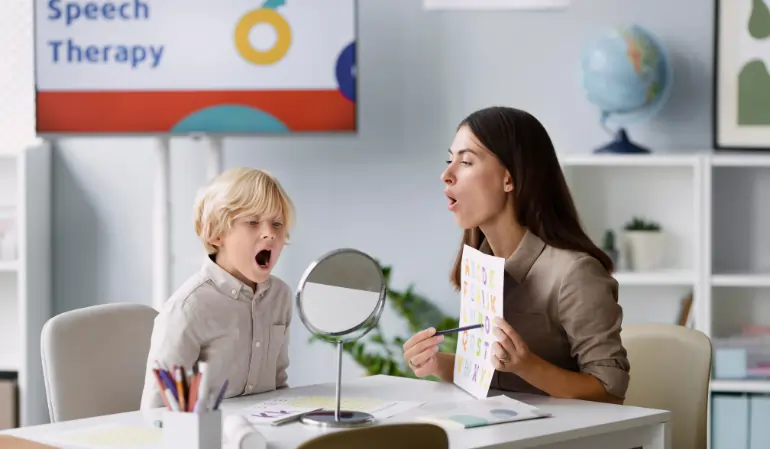
It is a confusing spot to be in. Your child follows every instruction you give. They fetch their shoes when asked. They point to the fan. Yet, when it comes to speaking, there is silence. You know they are smart. You know they understand. So, why aren’t the words coming out? This gap between expressive and receptive language is one of the most common reasons parents seek help. It isn’t necessarily a sign of a permanent delay, but it is a signal that your child’s “output” isn’t quite catching up to their “input.”
Table Of Contents:
The Difference Between Understanding and Speaking
The short answer is that understanding and speaking are two completely different brain functions. Receptive language is the ability to understand information, words, sentences, and gestures. Expressive language is the ability to use those sounds and signs to communicate a message.
Think of it like a computer. Your child has a great hard drive (understanding), but the printer (speech) is currently jammed. When a child has strong receptive skills but weak expressive skills, they often get frustrated. They have ideas, but no way to export them.
Why the Gap Happens
There isn’t just one reason for this disconnect. Sometimes, it is a matter of motor planning. The brain knows the word, but the mouth muscles haven’t figured out the “dance” required to say it.
Other times, it could be a “late talker” profile where the child is simply a late bloomer. However, waiting too long can lead to behavioral issues because the child feels misunderstood. At AIMS, we see this often. A child who can’t talk but understands everything will eventually start screaming or biting to get their point across. It is their only tool left in the box.
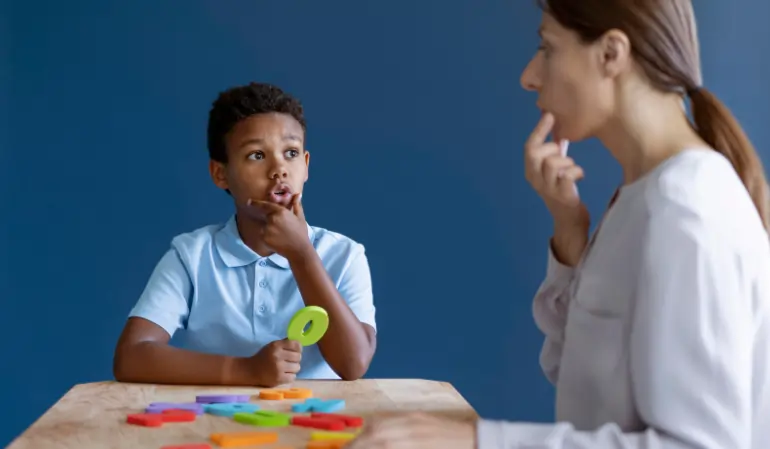
How Expressive and Receptive Language Work Together
In typical development, these two skills grow side-by-side, but receptive language almost always leads the way. We understand “No” long before we can say it.
When the gap becomes too wide, it’s time for a professional look. A speech-language pathologist doesn’t just “teach words.” They look at the whole picture. Are there enough gestures? Is there eye contact? Is the child using sounds to represent objects? Bridging the expressive and receptive language gap involves building those motor pathways and giving the child a reason to speak rather than just point.
Real-World Signs to Watch For
If your child is 18 to 24 months and still hasn’t hit the 50-word mark, don’t panic, but don’t ignore it either. Watch how they interact.
- Do they follow two-step commands? (e.g., "Pick up the toy and put it in the box.")
- Do they use at least 10–15 consistent gestures?
- Are they making a variety of consonant sounds like p, b, m, or d?
If they are doing the first two but failing the third, they are likely stuck in that “input-only” phase.
Helping Your Child at Home
You are their first teacher. While professional help is vital, what you do in the living room matters just as much.
- Narrate everything: Talk like a sports commentator. "Mommy is washing the red cup. Cup in the water. Scrub, scrub, scrub."
- Pause and wait: This is the hardest part. When they point to the milk, don't give it immediately. Count to five in your head. Give them the "space" to try a sound.
- Offer choices: Instead of asking "What do you want?", ask "Do you want apples or bananas?" while holding both up.
Final Thoughts
The fact that your child understands everything is actually a fantastic sign. It means their cognitive “engine” is running perfectly. They just need help connecting the transmission to the wheels. Are you ready to stop guessing and start helping them find their voice?
FAQ
The short answer? No. While some kids do just “pop” later, early intervention is much more effective. If there is a hurdle, we want to clear it now before it affects their social skills or school readiness.
Actually, the opposite is true. Using simple signs (like “more” or “all done”) reduces frustration. It gives them a bridge to use while their speech muscles are still catching up. Once they can say the word, they usually drop the sign.
It doesn’t “cause” it in a medical sense, but it doesn’t help. Speech is social. A tablet doesn’t talk back or respond to your child’s sounds. The more time they spend with a screen, the less time they spend practising the “give and take” of real conversation.
Absolutely. Many highly intelligent children have speech delays. Speech is a motor and linguistic skill, not just a measure of “brightness.” Understanding physics won’t help you if your tongue doesn’t know where to go for the “th” sound.