

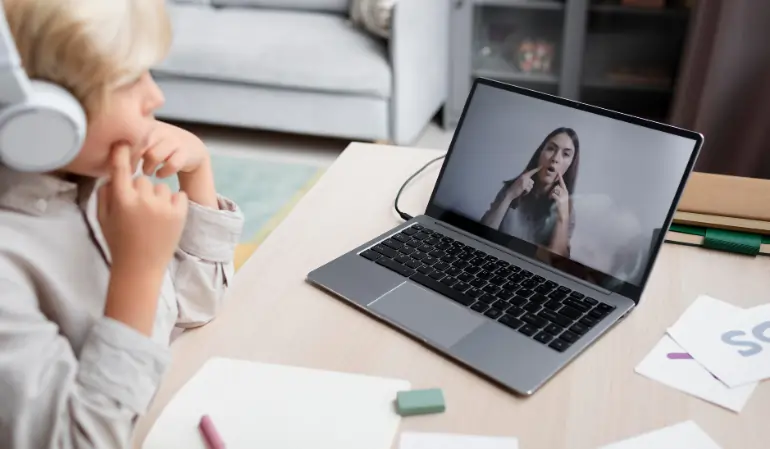
The idea of your child sitting in front of a laptop to learn how to talk feels a bit counterintuitive. We’ve been told for years that screen time is the enemy of development. But here you are, balancing a hectic schedule, limited local experts, and a child who needs help now. You’re wondering, can online speech therapy deliver the same results as sitting in a therapist’s office? The short answer? Yes. In many cases, it isn’t just “as good” it’s better.
By bringing the expert into your living room digitally, you’re training your child in their natural environment. This isn’t about passive watching; it’s about active, coached interaction that bridges the gap between the clinic and real life.
Table Of Contents:
Is Teletherapy Effective for Child Developmental Delays?
The short answer is that clinical outcomes for teletherapy are equivalent to in-person sessions for most speech and language delays. Research consistently shows that children make similar progress regardless of whether the therapist is in the room or on the screen.
At AIMS, we’ve seen that online speech therapy works because it relies on “parent coaching.” In a clinic, the child might perform for the therapist and then stop the moment they walk out the door. In an online session, the parent is the primary facilitator. You learn the techniques, the prompts, and the cues. This means the therapy doesn’t end when the Zoom call does; it continues through dinner, bath time, and play.
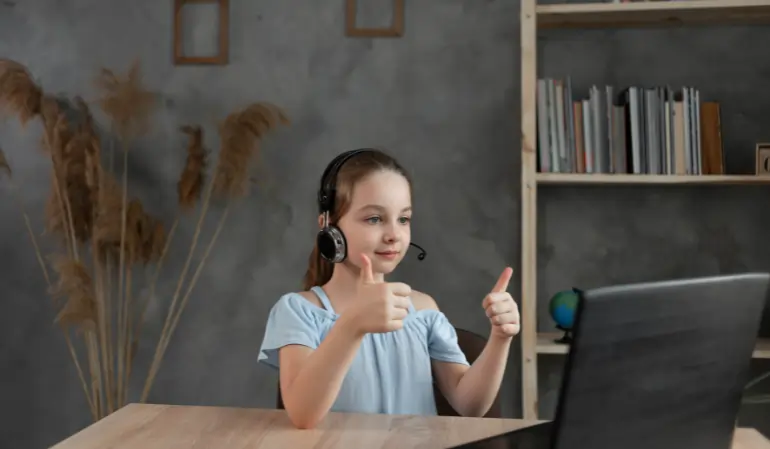
Why Kids Often Respond Better to the Screen
It sounds strange, but many children are actually more focused during a digital session. There are a few reasons for this.
- Comfort Zone: There’s no "white coat syndrome." Your child is on their favorite couch, surrounded by their own toys. They feel safe, which makes them more willing to take risks with new sounds.
- Visual Engagement: Modern teletherapy tools use interactive games and digital rewards that are highly motivating for a tech-native generation.
- Focus: For children with certain sensory sensitivities, a quiet room at home is far less overwhelming than a busy clinic with new smells and bright lights.
What to Expect in an Online Session
If you’re picturing a boring video call, think again. These sessions are fast-paced and high-energy.
The therapist uses a mix of digital tools and physical items you already have at home. You might be asked to bring a bowl of cereal, a favorite car, or a picture book to the camera. We use these everyday objects to build functional communication. This approach ensures that your child is learning to use language in the exact context where they need it most.
The Role of Parent Coaching
We provide an online service that empowers you. You aren’t just a spectator. You are the therapist’s hands and ears in the room. This model turns you into an expert on your child’s development.
When you see how a therapist handles a specific “stalling” tactic or how they model a sound, you can replicate it five minutes later when the session ends. This “round-the-clock” reinforcement is why many of our online families see rapid improvements in expressive and receptive language skills.
When is In-Person Therapy a Better Choice?
While online speech therapy is a powerhouse tool, it isn’t a universal fix. Some children with significant physical motor challenges or severe behavioral needs might require the physical touch and specialized equipment only available in a clinic.
If your child cannot attend to a screen for even a few minutes or if they have complex feeding and swallowing issues, we usually recommend a hybrid approach or full in-person sessions. The goal is the best outcome for the child, not just convenience.
Final Thoughts on Online Speech Therapy
The digital divide is shrinking, and the results speak for themselves. Online therapy isn’t a “lite” version of the real thing; it’s a modern, data-driven way to integrate healing into your daily routine. Why wait on a months-long clinic list when you can start making progress today from your own kitchen table?
FAQ
The short answer? They don’t have to! We don’t expect a toddler to stare at a screen for 45 minutes. These sessions often involve the therapist watching the child play and then coaching the parent on how to intervene. It’s more about the interaction than the screen itself.
Usually, yes. You save on travel costs, parking, and time off work. Plus, many centers offer competitive rates for teletherapy because it reduces their overhead costs. It’s a win-win for your wallet and your schedule.
Just a stable internet connection and a tablet or laptop with a camera. A bigger screen is better than a phone so your child can see the therapist’s mouth movements clearly. No fancy software is usually required.
Most major providers now recognize teletherapy as a standard of care and cover it just like an office visit. Always check with your specific provider first, but the “telehealth gap” has largely disappeared in recent years.