How can parents spot learning disabilities in their preschool-aged children?
Early childhood development is a critical time for the formation of learning skills. Although each child’s brain develops in a unique way, they may occasionally face early learning difficulties. A child’s future academic success, self-assurance and social integration are greatly impacted by early detection of learning disabilities.
In this blog we’ll go over some of the telltale signs from preschool itself and how parents can be aware of them.
Table Of Contents
What is Learning Disability?
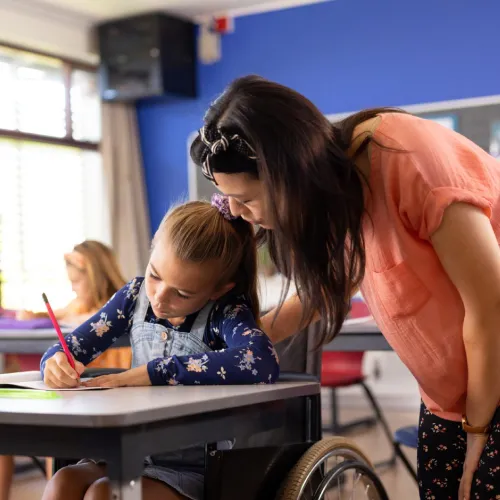
A child is said to have a learning disability if they have particular difficulties and challenges in their learning process. The child’s distinct learning styles are the reason for this, not their lower intelligence. Reading, writing, counting, memory and attention are some areas where these are evident.
The child’s confidence, social integration and future academic success can all be significantly impacted by the early detection of learning disabilities. We will go into great detail about the signs, causes and strategies that parents can use to help their children overcome learning disabilities in this blog.
Learning Disabilities Symptoms
Talking later than other kids:
A learning disability may be detected early if a child speaks later than other preschoolers. After the age of one and a half to two years children typically begin speaking in short sentences. However, it is a sign that parents should be aware of when some kids exhibit a noticeable delay in developing these sentences.
- Finding it hard to pick up new words quickly.
- Repeating basic grammatical mistakes in phrases.
- Displaying a lack of interest in social interaction.
- Displaying challenges with social communication and behaviour.
Difficulties with pronunciation:
Some young children in preschool might struggle to pronounce words correctly. Early indicators of learning disabilities include frequently omitting specific letters, mispronouncing words or pronouncing the same word differently. A child’s language development and communication abilities may be impacted.
- Saying the same word incorrectly on a regular basis.
- Avoiding specific sounds or letters.
- Speaking is a challenge.
- Having trouble reiterating what someone else has said.
- At this point it is crucial that parents and educators pay attention and provide support.
Slow vocabulary growth, often unable to find the right word:
Some preschoolers pick up and use new words slowly. Early indicators of learning disabilities may include frequent confusion and trouble finishing sentences.
- Not utilizing a word count that is age-appropriate.
- Often being silent or having trouble finding the right words to say.
- Using the same words over and over again without trying new ones.
- Using hand gestures or other people's assistance to make concepts clear.
- Here, parents’ and educators’ active involvement is crucial.
Difficulty rhyming words:
Children in preschool can typically identify and repeat rhymes such as ‘crow-crow’ and ‘ball-call’, etc. However, it might be an early indicator of learning disabilities if they can’t pronounce the right rhymes or have trouble connecting when they hear such words.
- When asked to recite rhymes they display confusion.
- Has trouble recognizing rhyming words and may show less interest in rhymes, songs, and poetry.
- Unable to quickly follow along when playing games with rhymes.
- The basis for language development and reading proficiency is the capacity to identify rhymes.
Difficulties learning the alphabet, numbers and days of the week:
The alphabet, numbers and days of the week are typically introduced to preschoolers gradually. However, it could be an early indicator of learning disabilities if they consistently struggle to recall, pronounce or identify these words.
- Inability to identify and name letters.
- Recalling the numerical sequence is difficult.
- Errors are frequent in counting tasks.
- The days of the week are often forgotten or difficult to pronounce.
- Here parents’ and educators' constant supervision and help are essential.
Extremely restless and easily distracted:
Certain preschoolers may find it challenging to remain motionless while concentrating on an activity. Early indicators of learning disabilities include frequent behaviours like getting up a lot and quickly focusing on tiny sounds and movements in their surroundings.
- Incapacity to focus on one thing for even a brief amount of time.
- Difficulty finishing play and educational tasks.
- Unable to sit still and constantly moving around.
- Inability to pay attention to and follow directions.
- At this point parental and teacher cooperation is crucial.
Trouble interacting with peers:
Making friends and taking part in group activities can be challenging for some preschool-aged kids. When social skills like cooperation sharing and waiting are compromised during play it could be a precursor to learning disabilities.
- Displaying a lack of desire to play with friends.
- Removing oneself from group activities.
- Unable to articulate their feelings.
- Overreacting to small failures.
- Social interaction skills are essential for learning and mental development.
- Useful Ways to Improve Learning Difficulties
Useful Ways to Improve Learning Difficulties
- Create a consistent schedule by designating specific times for studying, playing and relaxing.
- To make difficult subjects easier for your child to understand, break them up into manageable chunks.
- Make learning more interesting by using visual aids like games, activities and pictures.
- Give them credit for even the smallest accomplishments to help them feel more confident.
- Maintaining regular communication with teachers will enable you to assess your child’s development and make the required corrections.
- Take expert advice or care if required from a reputed centre.
FAQ
When a child struggles in certain learning-related areas that deviate from their typical level they are said to have learning difficulties. Reading, writing, math focus and memory may all be impacted.
Preschoolers may exhibit early indicators like attention deficit disorder, speech delay and trouble learning letters and numbers.
Don’t. A child’s low IQ is not the cause of learning difficulties. A large number of kids may have high or normal intelligence.